We Are Afghan Women by George W. Bush Institute
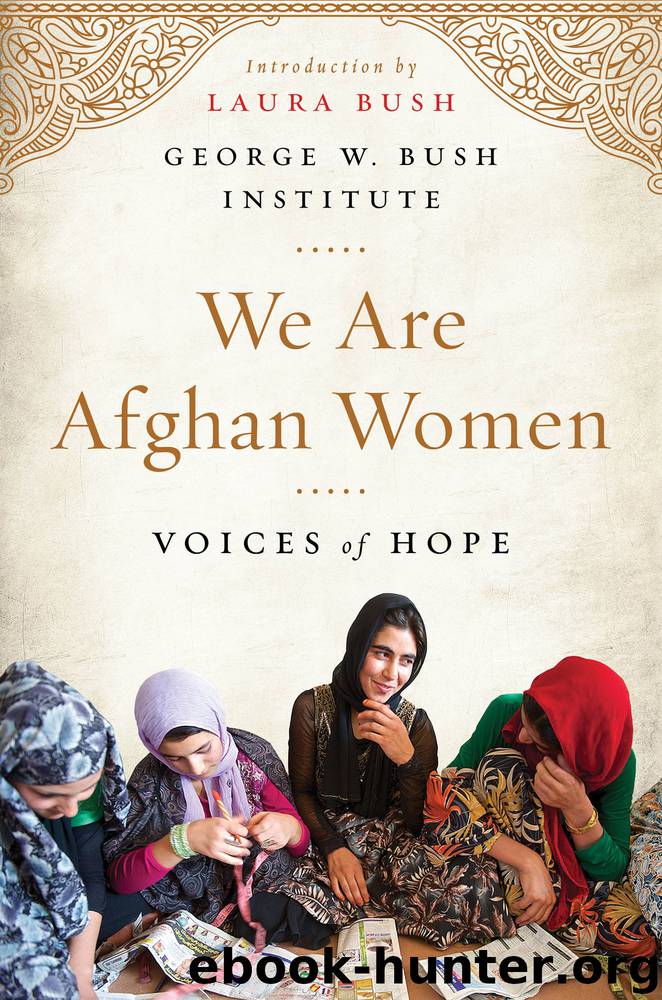
Author:George W. Bush Institute
Language: eng
Format: epub
Publisher: Scribner
Freshta Hazeq has endured death threats, threats to kidnap her children, fires, and property destruction at her office. Bribes have been paid to try to drive her out of business. The Afghan police have told her to hire personal guards. And all of this because she decided to start her own company in a traditionally male field: printing. Born into a liberally minded Kabul family, she would otherwise be like any other busy, working mother of small children. Except that she has chosen, as a woman, to build a business and reach out on behalf of other women. She began this effort from the time she was in college, and she has even sought to train Islamic mullahs to rethink the rights and roles of women.
• • • • • • • • •
I was born in Kabul and I grew up there until the Taliban time. When the Taliban came, we went to Pakistan and from there we went to Iran, and then we went back to Pakistan. We had an easier time than some families because my father was an electrical engineer. But from a young age, my brother and I were going to school and working in Pakistan so our family could survive. We came back to Kabul in 2002, and I studied social science at Kabul University. I liked social science because after the years in Iran and Pakistan, I felt like I didn’t know anything about Afghanistan. Even when we lived in Kabul, it was too dangerous to travel to the provinces. I only knew Kabul.
Along with going to school, I kept working. I had studied English, and I was hired to be a translator for an international nonprofit. For the first time, I traveled to all the different provinces in Afghanistan, and because I was translating for a gynecologist, I saw up close many of the issues facing women. When I traveled to the Central Highlands, I saw that nearly all the women didn’t have shoes, they were walking in their bare feet. And they didn’t have soap. They washed their hands with ash, which damaged their skin. If these women were lucky enough to live in a small house, all their farm animals lived inside with them. But many of the women didn’t even have houses—they lived in caves. And most were hungry—they didn’t have anything to eat.
When I went to villages in the province of Badakhshan, which is on the border with China, I saw the people living in the mountains. They had spent their whole life in the mountains and at that time nobody traveled to their province. They didn’t know that other people were living in places beyond their own district. They thought they were the only people. The only grain they had was barley, they had never seen or heard of wheat bread. All they cooked was barley. And they also ate a plant that they fed to their animals. The plant was poisonous and would completely explode their stomachs, but they had no choice because they were hungry and there wasn’t anything else to eat.
Download
This site does not store any files on its server. We only index and link to content provided by other sites. Please contact the content providers to delete copyright contents if any and email us, we'll remove relevant links or contents immediately.
| Elections & Political Process | Ideologies & Doctrines |
| International & World Politics | Political Science |
| Public Affairs & Policy | Specific Topics |
| United States |
The Secret History by Donna Tartt(19032)
The Social Justice Warrior Handbook by Lisa De Pasquale(12183)
Thirteen Reasons Why by Jay Asher(8884)
This Is How You Lose Her by Junot Diaz(6872)
Weapons of Math Destruction by Cathy O'Neil(6261)
Zero to One by Peter Thiel(5782)
Beartown by Fredrik Backman(5734)
The Myth of the Strong Leader by Archie Brown(5491)
The Fire Next Time by James Baldwin(5424)
How Democracies Die by Steven Levitsky & Daniel Ziblatt(5211)
Promise Me, Dad by Joe Biden(5141)
Stone's Rules by Roger Stone(5079)
A Higher Loyalty: Truth, Lies, and Leadership by James Comey(4946)
100 Deadly Skills by Clint Emerson(4911)
Rise and Kill First by Ronen Bergman(4776)
Secrecy World by Jake Bernstein(4738)
The David Icke Guide to the Global Conspiracy (and how to end it) by David Icke(4697)
The Farm by Tom Rob Smith(4500)
The Doomsday Machine by Daniel Ellsberg(4481)
